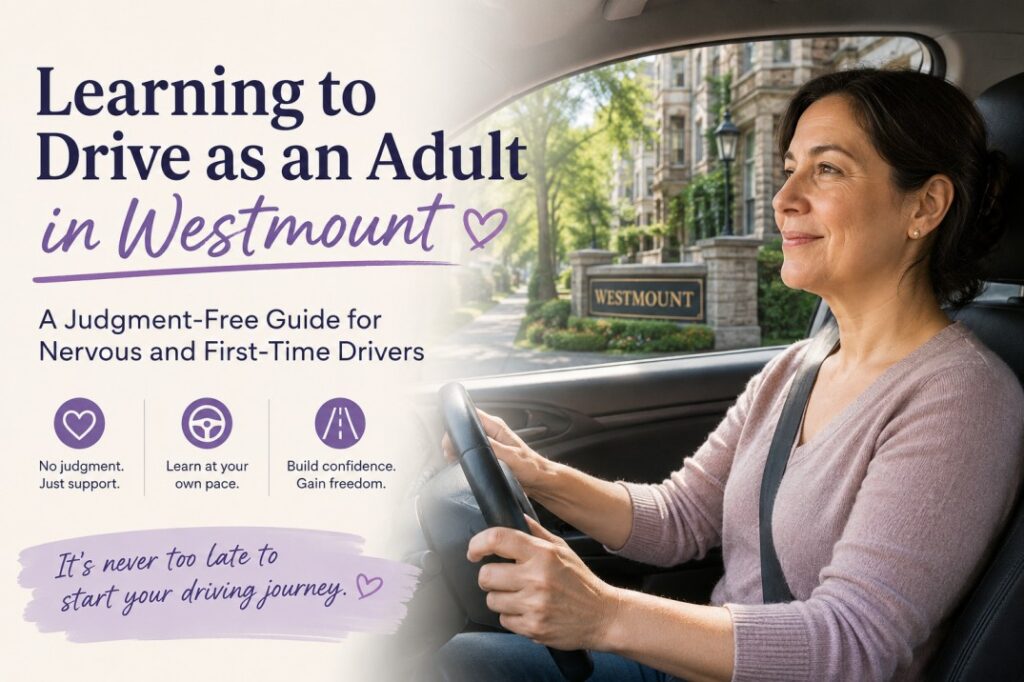
If you’ve put off getting your driver’s licence for years — maybe even decades — you are far from alone. Every week, adults across Westmount, Notre-Dame-de-Grâce, Montreal West, and the surrounding neighbourhoods walk into a driving lesson for the first time, often carrying a mix of relief and nerves. Some never needed a car in a walkable, transit-friendly part of Montreal. Some had a bad experience behind the wheel years ago and never went back. Others simply never got around to it as teenagers and now find themselves needing a licence for a new job, a growing family, or more independence.
Whatever brought you here, this guide walks through exactly what to expect from adult driving lessons in Westmount, how Quebec’s licensing process actually works for adult learners, and how the right instructor can turn driving anxiety into quiet confidence.
You’re Not the Only Adult Learning to Drive
There’s a quiet myth that driving lessons are only for sixteen-year-olds. In a city like Montreal, where many neighbourhoods are dense and well served by public transit, it’s genuinely common for adults in their late 20s, 30s, 40s, and beyond to be getting behind the wheel for the first time. Westmount’s mix of long-time residents and newer arrivals — including people who moved from countries or cities where driving wasn’t part of daily life — means our instructors regularly work with adult students who have never driven a car at all.
A good driving school treats this as completely normal, because it is. There’s no “behind schedule” when it comes to learning to drive. The goal isn’t to catch up to where a teenager would be; it’s to build the specific skills and confidence you need for your own life in your own neighbourhood.
How Quebec’s Driver Licensing Process Works for Adults
Quebec’s licensing system, run by the SAAQ (Société de l’assurance automobile du Québec), follows the same structured path for new drivers regardless of age. Knowing the steps in advance removes a lot of the mystery — and a lot of the anxiety.
1. The driving course. A recognized driver education course covering both theory and in-car practical training is a requirement to obtain a Class 5 passenger vehicle licence in Quebec. The course is broken into phases that alternate between classroom-style theory and on-road sessions with an instructor, so you build knowledge and hands-on skill at the same time rather than front-loading months of theory before ever touching a steering wheel.
2. Your learner’s licence. After completing the first phase of theory and passing an in-school knowledge evaluation, you become eligible to get your learner’s licence from an SAAQ service centre. This licence lets you drive accompanied by someone with a full licence while you continue training.
3. Continued practical training. You’ll keep working through in-car sessions with your instructor, gradually taking on more complex driving situations — quiet residential streets first, then busier arteries, then highway driving, parking, and the situations specific to Montreal winters.
4. The SAAQ knowledge test and road test. Once you’ve held your learner’s licence for the required waiting period and completed your training, you book your official knowledge test and, later, your road test with the SAAQ.
5. Your probationary licence, then your full licence. Passing the road test gets you a probationary licence, and after the probationary period, your full Class 5 licence.
None of this happens overnight, and that’s by design — the staged process gives adult learners time to genuinely absorb skills rather than cram for a single test. A good instructor will map this timeline out with you on day one so you always know where you stand.
Why Adult and Nervous Drivers Need a Different Teaching Approach
Teaching a nervous 35-year-old to merge onto the highway is not the same task as teaching a confident 16-year-old. Adult students often bring things into the car that teenagers usually don’t: a specific bad memory behind the wheel, self-consciousness about “starting late,” or genuine physical tension that shows up as a white-knuckle grip on the wheel. The most effective driving instructors for this group share a few traits.
Patience without condescension. You want an instructor who explains things clearly without making you feel like you’re being lectured or rushed. Repeating an explanation calmly, three different ways if needed, should feel normal — not like a failure on your part.
A pace that’s actually yours. Some adult students want to spend an extra hour or two practicing three-point turns before ever discussing highway merges. Others want to move quickly once they feel steady. A strong instructor adjusts the lesson plan to the person in the seat, not the other way around.
Calm, specific feedback in the moment. Vague reassurance (“you’re doing great!”) doesn’t actually reduce anxiety the way specific, real-time guidance does — “ease off the brake a touch earlier here” gives you something concrete to act on, which builds genuine confidence rather than a temporary feeling of being soothed.
Private lessons over group settings. For most nervous adult drivers, one-on-one instruction in the car removes the social pressure that comes with being watched or compared to other students, letting you focus entirely on the road.
Common Fears We Help Adult Drivers Work Through in Westmount
Westmount and the surrounding parts of Montreal present a specific mix of driving challenges, and naming them upfront tends to make them less intimidating.
Parallel parking on narrow, tree-lined streets. Westmount’s residential streets are charming and often tight, with cars parked close together. We treat parallel parking as a skill broken into small, repeatable steps rather than a single intimidating moment — and we practice it far more than the SAAQ road test technically requires, because confidence here carries into everyday life.
Merging onto major arteries and highways. Whether it’s Décarie, the Ville-Marie Expressway, or simply merging onto a busy boulevard, highway entry is one of the most common sources of adult driving anxiety. We build up to it gradually, starting with shorter, lower-speed merges before tackling busier interchanges.
Roundabouts and complex intersections. Montreal has its share of unconventional intersections. We walk through the right-of-way rules slowly and repeat practice runs until the decision-making becomes automatic rather than a moment of panic.
Winter driving conditions. Snow, ice, and reduced visibility are real and valid concerns for new drivers in Quebec. Lessons can include guidance on adjusting following distance, braking technique, and what to do if a vehicle starts to skid — skills that matter far beyond the licensing test itself.
Driving with passengers watching. Many adult students feel more self-conscious with a friend or family member in the car than they ever do with their instructor. Building independent confidence during lessons is what eventually makes driving with others feel ordinary instead of stressful.
What to Expect From Your First Lesson
Walking in without knowing what’s about to happen is often the most anxiety-inducing part of the entire process — so here’s a realistic picture.
Your instructor will start with a conversation, not a test. Expect questions about your experience level (including zero experience), any specific worries you want to flag, and what you’re hoping to get out of lessons. From there, the first session usually takes place in a quiet, low-traffic area: getting comfortable with mirrors, seat position, basic controls, starting, stopping, and steering before any real traffic enters the picture. Nobody is thrown onto a busy street in lesson one.
By the end of a first lesson, most adult students report feeling some combination of tired and surprised — tired because focused concentration is genuinely effortful, and surprised because the version of driving they’d built up in their head was usually scarier than the reality of slowly easing a car forward in an empty parking lot or quiet side street.
Manual or Automatic? What Adult Beginners Should Know
Most adult students in Montreal choose to learn on an automatic transmission, simply because it removes one layer of coordination while you’re already building several new skills at once — steering, mirror checks, hazard awareness, and traffic rules. That said, some students specifically want manual transmission experience, whether for a particular vehicle they own, a job requirement, or personal preference. A flexible driving school will offer both, often with simulator practice available for manual transmission basics before you take it onto the road.
Choosing a Driving School in Westmount: What Actually Matters
If you’re comparing options, a few details are worth checking before you book:
A school should be SAAQ-recognized, meaning its course and instructors meet the province’s official driver education standards — this matters both for the validity of your training and for keeping your timeline to a licence on track.
Look for flexible scheduling, including evening or weekend lessons if you’re balancing driving lessons with a full-time job, since rigid weekday-only availability is one of the most common reasons adult learners stall out partway through.
Ask whether the school offers pick-up and drop-off near your home or workplace in Westmount, NDG, or Montreal West — not having to arrange separate transportation just to get to your lesson removes a real logistical barrier.
Consider whether bilingual instruction is available, particularly if you’d feel more comfortable learning technical driving vocabulary in English or French specifically.
Finally, read recent reviews with an eye specifically toward how past students describe the instructor’s patience and communication style, since that single factor tends to matter more for adult and nervous drivers than almost anything else on this list.
Foire aux questions
Is it normal to learn to drive as an adult in Quebec? Yes. It’s increasingly common in Montreal-area neighbourhoods like Westmount, where many residents go years without needing a car. Driving schools regularly work with adult students who have never driven before.
How many lessons do adult beginners typically need? This varies widely depending on prior experience and comfort level, but most adult beginners benefit from a structured course combined with extra in-car practice sessions focused on their specific areas of concern, such as highway merging or parking.
Is the driving course mandatory if I’m over 25? Quebec’s driver education course applies to new drivers of any age and is required to obtain a Class 5 passenger vehicle licence, regardless of how old you are when you start.
Can I take driving lessons in English in Westmount? Many driving schools serving Westmount and the surrounding West Island and NDG area offer instruction in both English and French — it’s worth confirming with your specific school when booking.
What if I had a bad experience driving years ago, and I’m scared to try again? This is one of the most common reasons adult students come back to lessons, and a patient, judgment-free instructor will typically start at whatever pace feels manageable, often in an empty parking lot or quiet street, before building back up gradually.
Do I need my own car for lessons? No. Driving schools provide a dual-control vehicle for both in-car lessons and, eventually, the SAAQ road test.
Ready to Take the First Step?
Learning to drive as an adult doesn’t require catching up to anyone else’s timeline. It just requires a calm, structured starting point and an instructor who treats your nerves as normal rather than something to push through. If you’re in Westmount, NDG, Montreal West, or the surrounding area and you’ve been putting off this step for years, a single trial lesson is often enough to find out that the version of driving in your head is harder than the version on the actual road.