Parking is the moment that makes most SAAQ test candidates nervous. Your hands tighten. Your breathing shortens. You know the examiner is watching every inch of that wheel. But here’s the truth that driving instructors across Quebec repeat every single day: parking anxiety kills more tests than poor parking skills. This guide will give you the knowledge, the technique, and — most importantly — the unshakeable mental framework to nail parking with calm authority.
What’s at stake? Parallel parking is evaluated on every SAAQ road test in Quebec. Depending on which service centre administers your test, you will park on a real street between two vehicles or in a lot using orange cones — both require the same technique. A poor parking attempt costs you points; a dangerous one can end the test immediately.
Why Parking Feels Harder Than It Is
Here’s something the SAAQ examiner already knows: parking is a low-speed maneuver where nothing bad can happen quickly. Unlike merging onto an autoroute at 100 km/h, parallel parking unfolds slowly. You have time to correct. You have time to reposition. The examiner is not grading you on speed — they are grading you on control, observation, and the absence of dangerous actions.
The panic that test candidates feel comes from a mental mismatch: you’ve practiced parking hundreds of times, and you know how to do it, but suddenly having someone evaluate you triggers a fight-or-flight response that makes simple tasks feel impossible. The solution is to build a pre-parking ritual — a sequence so automatic that your body executes it without your anxious brain interfering.
The examiner is not trying to trick you. They are not hoping you fail. They simply want to see that you are safe. Safe is achievable.
The 3 Types of Parking You Must Know
Before we dive into confidence techniques, let’s make sure you know exactly what SAAQ examiners look for in each parking type.
- Parallel Parking (Most Common on SAAQ Tests)
This is the maneuver tested on virtually every Quebec road test. You will be asked to park parallel to the curb, between two vehicles (or cones), in one smooth sequence.
Step 1 — Signal and position alongside the front vehicle. Pull up alongside the car in front of your target space, keeping about one metre of space between your vehicles. Your rear bumpers should be approximately aligned. Signal right to communicate your intention.
Step 2 — Check mirrors and blind spots, then begin reversing. Check your left mirror, right mirror, and over both shoulders before engaging reverse. This shoulder check is worth points. Do it visibly and deliberately — the examiner is watching your head movements.
Step 3 — Reverse at a 45-degree angle. Turn your wheel sharply right and creep backward until your vehicle’s body is at roughly 45° to the curb. Keep your speed slow — you should be able to stop instantly at any moment.
Step 4 — Straighten, then cut left. When your front door is level with the rear bumper of the front car, start turning your steering wheel left (counterclockwise) to bring the front of your car into the space. Continue reversing slowly until your car is parallel to the curb.
Step 5 — Adjust and activate the parking brake. Creep forward or backward to center your car in the space, leaving appropriate room front and rear. Come to a complete stop, apply the parking brake, and shift into Park (automatic) or first gear/reverse (manual). Leave at most 30 cm from the curb.
SAAQ Rule to memorize: You may not park within 3 metres of a fire hydrant or within 5 metres of a stop sign or crosswalk. Before pulling up to any space, scan for these — the examiner may intentionally direct you near one to see if you notice.
- Angle Parking (Forward and Reverse)
Angle parking is simpler than parallel but still evaluated. The key insight most candidates miss: reversing out of an angle space is a two-part shoulder check. Before moving an inch in reverse, check behind you by looking over both shoulders — left first, then right — while using your mirrors. Cars approach from angles you can’t see in mirrors alone. When pulling into an angled space, position your vehicle to enter at a smooth arc, not a sharp crank at the last second. Aim to land centred in the space with your front bumper no closer than 20 cm to any line, wall, or curb ahead.
- Parking on a Hill
Hill parking is tested less frequently but can appear on your SAAQ route. The rule is based on simple physics: your front wheels must be turned to stop the car from rolling into traffic if the brakes fail. Facing uphill with a curb: turn wheels away from the curb (left) — if the car rolls, the curb stops it. Facing downhill with a curb: turn wheels toward the curb (right) — the curb acts as a block. No curb, uphill or downhill: turn wheels toward the shoulder (right) so any roll goes off-road, not into traffic.
The Confidence System: How to Own Your Parking
Knowledge of the maneuver isn’t the same as parking confidence. Confidence is a trained state, not a personality trait. Here’s the system that professional driving instructors use with students who freeze up under pressure.
The Pre-Parking Ritual
Every pilot runs a pre-flight checklist. Every surgeon does a time-out before an incision. Before every parking attempt on your SAAQ test, run this 5-second mental routine called the SCOPE Check:
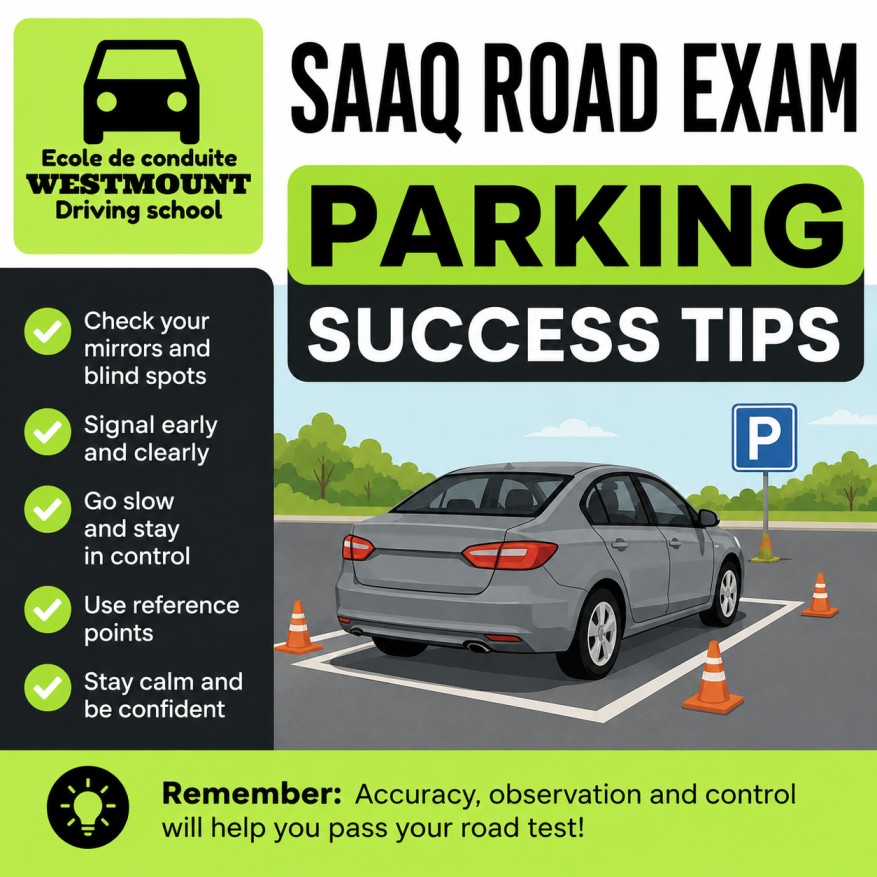
S — Space: Is this space large enough? (Aim for at least 1.5x your vehicle length for parallel.) C — Curb distance: Any hydrants, signs, or driveways to avoid? O — Observation: Mirrors checked? Blind spots checked? Pedestrians? P — Position: Am I correctly lined up to begin the maneuver? E — Execute slowly: No rush. Creep, correct, creep, correct.
Verbalize Your Observations (Quietly)
Talking through your actions — even in a whisper — does two powerful things: it keeps your brain engaged on the task rather than on anxiety, and it signals to the examiner that you are actively thinking about safety. Before you reverse, quietly say: “Checking left mirror… right mirror… shoulder check left… shoulder check right… clear.” This is not silly. It is professional.
Treat Corrections as Part of the Maneuver
This is perhaps the most misunderstood rule of the SAAQ parking evaluation: you are allowed to correct your position. If you reverse too far or your angle is wrong, you can pull forward and retry — within the same attempt. What examiners are marking is whether you handle corrections calmly and safely, not whether you land it perfectly on the first arc. Panic-correcting (jerking the wheel, accelerating to fix a mistake) is what costs points. A slow, deliberate adjustment shows control.
Slow Is Smooth. Smooth Is Safe.
The single most effective technique for test-day parking confidence is speed control. Almost every parking mistake — overshooting, poor angles, bumping a cone — happens because the driver went too fast. In a parking maneuver, you should be moving at the speed of a cautious walk. If you can’t stop within half a second, you are going too fast. Feather the brake gently throughout the entire maneuver.
Common SAAQ Parking Mistakes (And How to Avoid Them)
Forgetting to signal before pulling up to the parking space. Your turn signal must be on before you stop alongside the front car — not after. Skipping shoulder checks before reversing. This is one of the most-penalized omissions on the entire SAAQ test, not just parking. Make your head movement obvious. Rushing the maneuver to “get it over with.” Speed creates errors — slow down below what feels necessary. Ending up more than 30 cm from the curb. Practice with a measuring reference until you can judge 30 cm by sight. Not applying the parking brake after stopping. SAAQ evaluators specifically watch for this — pull that brake every single time. Abandoning the space without checking for traffic. When you signal to re-enter traffic, do a full mirror-and-shoulder check sequence exactly as you would when pulling away from any stop.
Automatic Failure Triggers: Hitting a cone (or curb with force), reversing without checking blind spots, or causing the examiner to physically intervene will end your test immediately. There is no recovery from these. Prevention: go slow, check mirrors, check blind spots — every time, no exceptions.
Practice Strategy: How to Train Your Parking Confidence
Raw repetition builds muscle memory, but deliberate practice builds confidence. Here’s the difference: deliberate practice means practicing under conditions that simulate test pressure, not just repeating the move in an empty parking lot.
Week 1–2: Foundations in an empty lot. Use four pylons to mark a space 1.5× your vehicle length. Practice the full parallel park sequence at walking pace. Repeat 10–15 times per session. Focus only on your reference points — not on anxiety.
Week 3: Add a passenger (the observer effect). Having someone watch you creates mild social pressure — a mild version of what you’ll feel with an examiner. Practice the full SCOPE check and verbal narration with your observer present. Ask them to give you a simple thumbs up or down on your shoulder checks.
Week 4: Real streets near SAAQ service centres. Quebec driving instructors strongly recommend practicing on the actual streets around your test location. You’ll learn the specific types of spaces, traffic density, and road conditions you’ll face on test day. Familiarity kills fear.
Final week: Pressure simulations. Ask your supervising driver or instructor to play examiner. They sit in silence, take notes, and say only what an examiner would say. This social simulation is the most effective anxiety-reduction tool available before test day.
Test Day: The Mental Game
On the morning of your SAAQ road test, your parking technique is already as good as it’s going to get. What determines your score now is your emotional state. Arrive 15–20 minutes early so you’re not rushing — a calm check-in sets a calm tone for the entire test. Adjust your seat, mirrors, and seatbelt before the examiner gets in the car. This visible act of preparation signals competence and puts you in control. Take one slow breath before any maneuver. One breath takes three seconds and costs zero points. It resets your focus entirely. If you mishear or misunderstand the examiner’s instruction for a parking space, calmly ask for clarification. Examiners are not trying to trick you — asking shows professionalism. If you make a mistake in parking, complete the maneuver safely and continue. One imperfect park does not fail a test. Panicking about it and making subsequent errors often does.
Remember this: The SAAQ evaluates safety, control, and observation — not perfection. A calm driver who executes a two-attempt parallel park while checking mirrors at every step scores better than a nervous driver who rushes a one-attempt park without adequate observation checks.
Final Word: Parking Is a Skill. Confidence Is a Choice.
Every SAAQ examiner has watched thousands of candidates park. They know the difference between a nervous driver who still has good fundamentals and a genuinely unsafe driver. If you have practiced the sequence, if you know your reference points, if you check your mirrors and blind spots consistently, you will pass. The parking maneuver will not trap you if you’ve prepared it deliberately. On test day, remember: you are not trying to impress the examiner with speed or flair. You are showing them that Quebec’s roads are safer because you’re on them. Park slowly. Check everything. Breathe. And trust the hours you’ve put in. You’ve got this