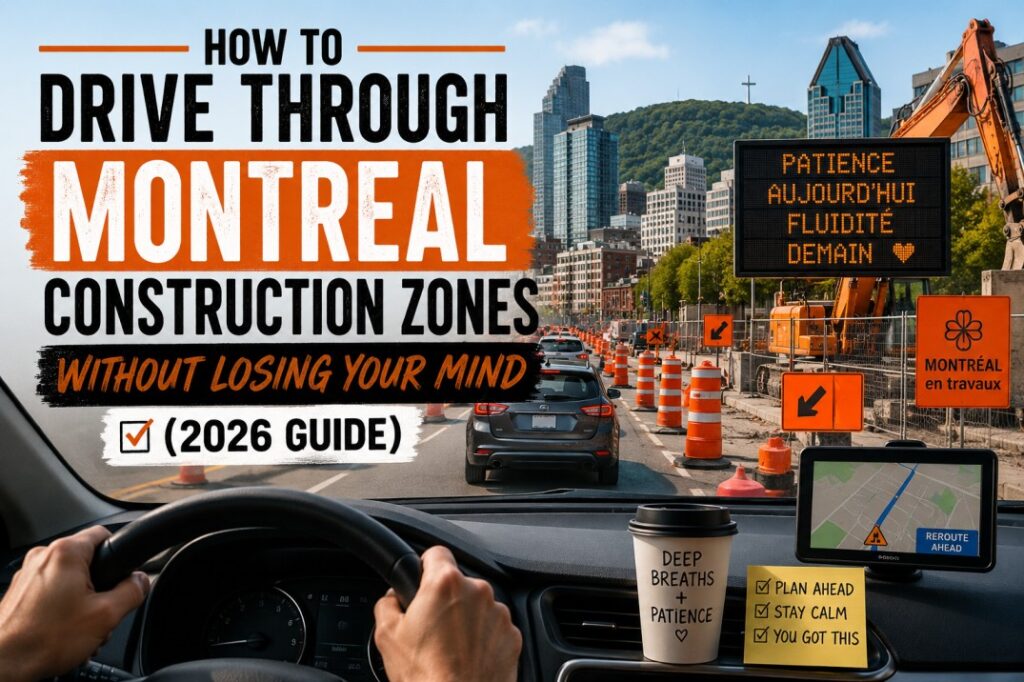
If you’re a new driver in Montreal, you’ve probably already noticed something that experienced drivers here take for granted: this city is always under construction. Orange cones, lane shifts, detoured streets, missing signage, and impatient drivers behind you — construction zones are one of the most stressful environments for anyone learning to drive, and almost no one prepares you for them properly. At Westmount Driving School in downtown Montreal, we hear the same thing from students every week: “I was fine in practice, but then I hit a construction zone and completely froze.” This guide exists to change that. Whether you’re preparing for your SAAQ road test or just trying to survive your first few months behind the wheel in Montreal, here’s everything you need to know about driving through construction zones — safely, legally, and without panic.
Why Montreal Construction Zones Are Especially Hard for New Drivers
Montreal consistently ranks among the most road-construction-heavy cities in North America. Between the aging infrastructure, harsh freeze-thaw winters that crack roads every year, and major ongoing projects across the island, there is virtually no period when large parts of the city are not actively being rebuilt. For new drivers, this creates a unique challenge. You’re still building your fundamental driving habits — checking mirrors, managing speed, reading signs — and then suddenly the road changes. Lanes narrow. Signs disappear or point in confusing directions. Pavement becomes uneven. Trucks pull in and out without warning. And behind you, Montreal drivers are not known for their patience. The result? New drivers either freeze up, make sudden last-minute moves, or simply avoid certain roads entirely — which limits where they can go and builds long-term driving anxiety. Understanding the rules and developing a system for navigating these zones fixes all of that.
The Law: What Quebec Says About Construction Zones
Before we get into practical tips, you need to know the legal requirements. Ignorance of these rules is not an excuse on your SAAQ road test — or in real life. When workers are present, fines for speeding in Quebec construction zones are doubled. A fine that would normally cost you $100 can cost $200 or more inside a construction zone, and demerit points apply as well. The standard reduced speed limit inside most Montreal construction zones is 50 km/h, but always watch for posted signs — some zones drop to 30 km/h, especially where workers are active, or lanes are very narrow. You must respect all temporary signage, even if it contradicts your usual knowledge of the road. You must yield to flaggers — construction workers directing traffic —, and their instructions override traffic lights and signs. You must not change lanes inside a clearly marked no-lane-change construction zone. You must leave adequate following distance because the reduced speed and uneven surfaces mean you need more stopping room, not less.
The Most Affected Areas in Downtown Montreal Right Now (2026)
Construction in Montreal shifts constantly, but downtown and surrounding neighbourhoods are almost always affected. As a student driver with Westmount Driving School, you will almost certainly encounter active construction zones in these areas. Rue Sherbrooke has ongoing water main and road surface work in multiple segments, lane reductions are common, and the bike lane creates additional merge complexity. Boulevard René-Lévesque sees heavy traffic combined with utility work, which means this artery frequently has reduced lanes and shifted traffic patterns, particularly between Guy and Peel. Rue Sainte-Catherine has been transformed by pedestrianization and revitalization work that has dramatically changed traffic flow through downtown, with new one-way sections and temporary closures appearing regularly. Griffintown and the new residential corridors are full of construction equipment, trucks entering and exiting sites, and temporary road surfaces due to rapid development. The Turcot Interchange area continues to affect drivers coming in and out of downtown from the west through secondary road work and ramp adjustments. As a new driver, you don’t need to memorize every active site. What you need is a system that works anywhere you encounter orange cones.
7 Practical Rules for New Drivers in Montreal Construction Zones
Rule 1 — Slow Down Before You Enter, Not After. Most new drivers react to construction zones — they see the cones, get startled, and brake suddenly. This is dangerous. When you see construction signs ahead, begin reducing your speed gradually and smoothly. Give yourself time to assess what’s ahead before you’re in the middle of it. The moment you see the first orange sign, start planning — not braking hard.
Rule 2 — Increase Your Following Distance Immediately. In normal downtown driving, a two-second following distance is standard. In a construction zone, move at least three to four seconds. Surfaces are often uneven or freshly patched, your visibility may be reduced by barriers and equipment, and the car ahead of you may stop suddenly if a flagger appears or a vehicle pulls out from a work site. Give yourself room. It is always the right call.
Rule 3 — Pick Your Lane Early and Commit. One of the most dangerous things new drivers do in construction zones is lane-change mid-zone. Lanes are narrower, barriers are closer, and visibility of other vehicles is reduced. If you are in the wrong lane heading into a construction zone, your best option is almost always to stay in your lane and navigate out of the zone first before correcting. Study your route before you drive it. If you know construction is ahead, decide which lane you need to be in before you reach it — not when you’re already inside the cones.
Rule 4 — Watch for Flaggers and Obey Them Immediately. Construction flaggers have full legal authority to control traffic. If one holds up a STOP sign or raises their hand, you stop — even if the light ahead is green. If one waves you through, you go — even if it feels uncertain. New drivers sometimes hesitate because the flagger’s instructions contradict what they expect. That hesitation causes problems. Trust the flagger. They can see the full situation; you cannot.
Rule 5 — Don’t Fixate on the Barriers. This is a psychological driving tip that your instructor at Westmount Driving School will tell you directly: you drive where you look. New drivers in construction zones tend to stare at the concrete barriers or orange cones to avoid them — and then drift toward them. Keep your eyes up and forward, focused on the lane ahead. Your peripheral vision handles the barriers. Your forward vision keeps you centred.
Rule 6 — Turn Off Distractions Completely. In a construction zone, this extends to music volume, passenger conversations, and GPS fiddling. Construction zones demand your full cognitive attention. The environment is changing, signs appear quickly, and you may need to react to a flagger, a merging truck, or a sudden lane shift with very little warning. Before entering a zone you know is ahead, adjust your GPS, lower your music, and tell passengers you need quiet for a moment. This is proper defensive driving.
Rule 7 — Stay Calm When Other Drivers Pressure You. Montreal drivers are assertive. In construction zones where everyone is slightly frustrated and moving slowly, tailgating and horn-honking increase. As a new driver, this is one of the most destabilizing experiences you can face. Do not let them rush you. Your safety matters more than the impatience of the driver behind you. Maintain your speed, maintain your following distance, and let them pass when it is safe to do so. You are not responsible for their emotions.
What to Do If You Get Confused Mid-Zone
Despite your best preparation, there will be times when the signage is unclear, lane markings have been painted over, or you genuinely don’t know where to go. Slow down immediately — speed is your enemy when you are uncertain. Follow the car in front of you because those vehicles are navigating the same signs you are. Look for temporary painted arrows or cones because construction crews almost always create a visible path even when permanent markings are gone. Do not stop suddenly unless a flagger tells you to — stopping mid-zone without warning creates a rear-end collision risk. If you genuinely took a wrong turn or ended up in a closed section, find the first safe legal place to stop and recalculate. Never reverse in a construction zone.
How Westmount Driving School Prepares You for Construction Zones
At Westmount Driving School, our instructors know downtown Montreal’s road conditions intimately. We don’t just teach you the rules in a classroom — we drive with you through real construction zones, on real Montreal streets, so that by the time you take your SAAQ road test or drive independently, none of this is new. We teach our students to read the road ahead, anticipate lane shifts, respond correctly to flaggers, and stay calm under pressure. These are skills that make you a safer driver for life — not just someone who passes a test. If you’re a new driver, a newcomer to Montreal, or someone who wants to refresh their skills and confidence on today’s roads, we’d love to help.